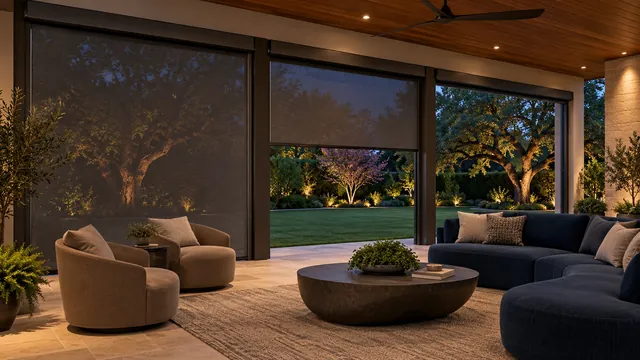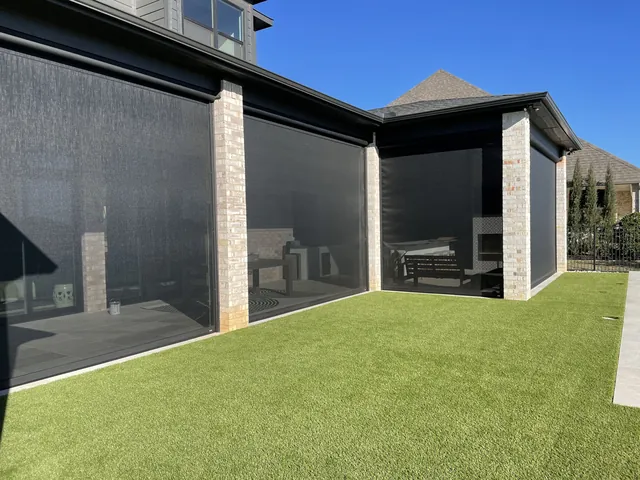
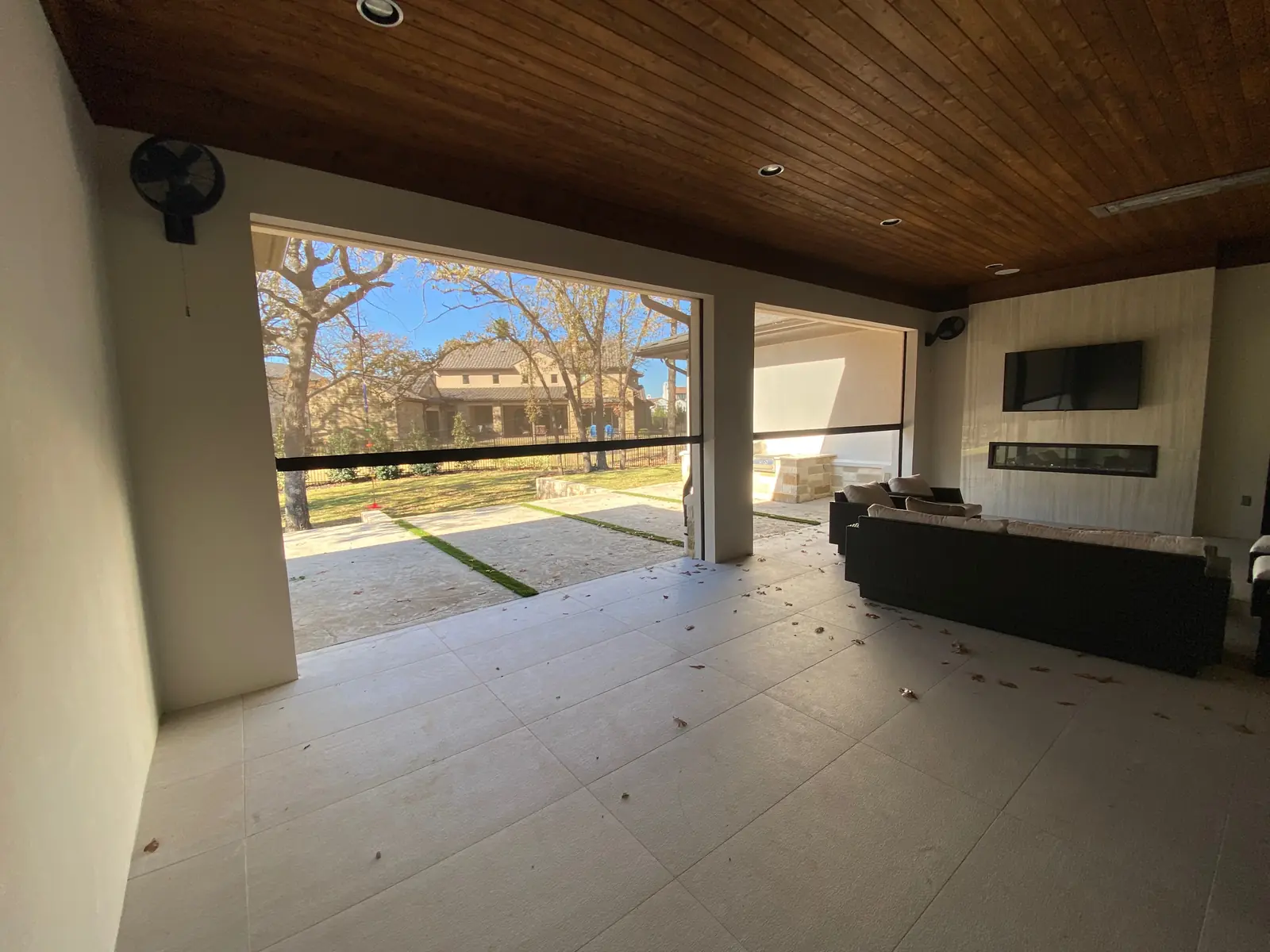
An exterior screen company really makes three things, and the skill is not in any one of them but in putting the right one on each opening. A patio is rarely all one problem: the wide span you look through wants to open and close, the narrow sides rarely do, and somewhere there has to be a way in and out that the insects do not use. So most patios end up with two of the three — a motorized screen across the main opening, fixed panels on the sides, a door at one end — chosen per opening and matched so the finished patio reads as one thing. Here is what each one is for.
Motorized ScreensThe Opening You Use
A motorized screen is for the opening you want open sometimes and closed others — almost always the wide span you look through and walk out of. The fabric rolls down from a housing above on a Somfy motor, running in side tracks, and comes back up out of sight when you do not want it. It is the piece that makes a patio adjustable: shade and insect protection on a tap when the afternoon sun is on it, a fully open view when the evening cools. If a patio gets only one thing, it is usually this, across the opening that matters most.
Fixed Screen PanelsThe Sides That Stay Closed
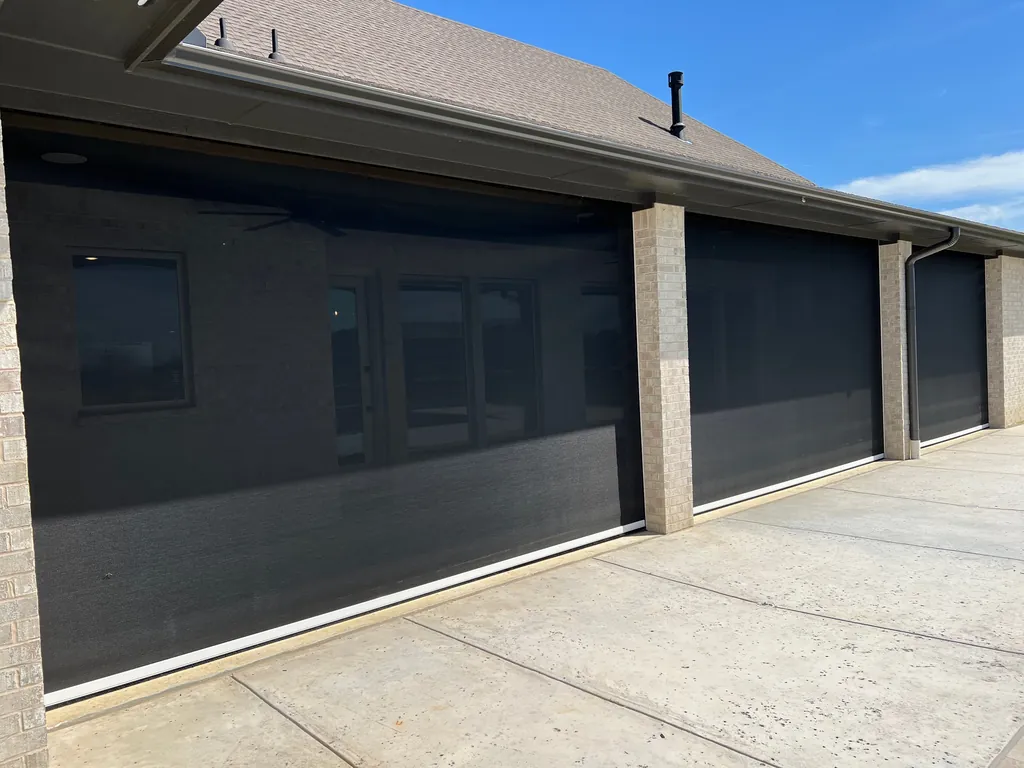
Not every opening needs to move. The sides of a patio, the gap beside a fireplace, the span under a staircase — these are almost always closed, so a fixed panel is the simpler, sturdier and less expensive answer. It is a framed screen made to the opening in SunTex, insect mesh, glass or polycarbonate, powder-coated to match the motorized screens beside it. Fixed panels do the quiet work of closing a patio in without a motor to buy or maintain, and they let the motorized screens go only where movement is actually worth paying for.
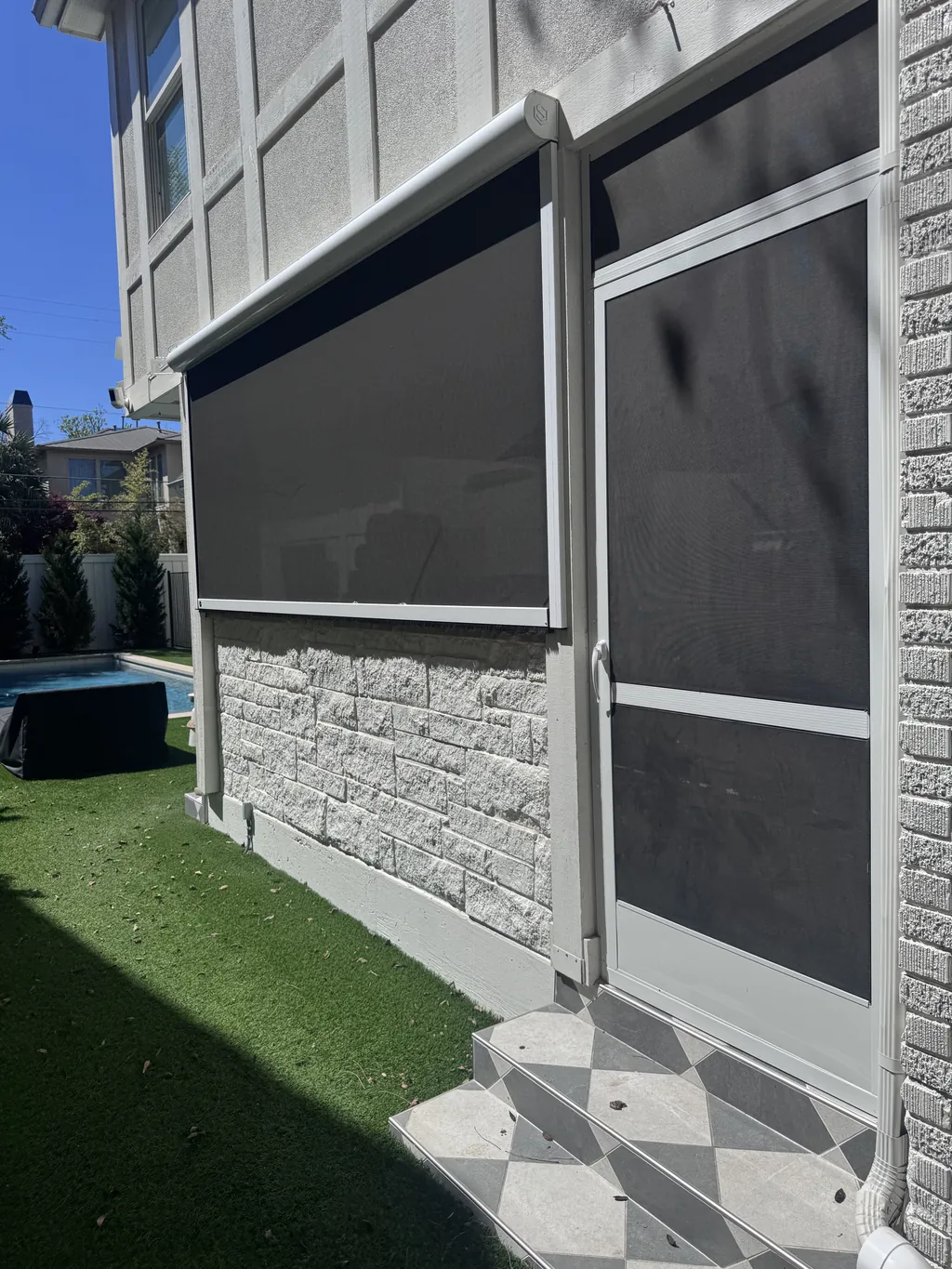
Screen DoorsThe Way In and Out
If you screen a patio, you need a way through it that the insects do not share. A screen door is built in the same frames and finish as the fixed panels, so it reads as part of the wall rather than an add-on, and it usually carries No-See-Ums mesh to stop the gnats while keeping the breeze — or SunTex 90 if that end takes the afternoon sun. It closes and latches like a proper door, not a flap, and it is what lets the rest of the screening actually stay sealed, because nobody has to leave a panel open to get out.
Two of the ThreeHow a Patio Comes Together
Most patios are a combination. A common one: a motorized screen across the main opening, fixed panels down the sides that never needed to move, and a door at one end to reach the yard. Another: fixed panels and a door closing a smaller covered porch, with no motor at all. We walk the patio and decide opening by opening — what has to move, what can stay put, where the door belongs — then match fabric, color and frame finish across all of it, so it looks designed rather than assembled from parts.
One LookA Shared Fabric Language
Because the three share a fabric and finish range, a mixed patio does not have to look mixed. We choose the weaves so the fixed panels and the motorized screen read the same from the yard, run the same frame color through the doors, and keep the lines consistent across openings of different sizes. A fixed SunTex 80 panel beside a motorized SunTex 97 screen will differ a little up close by design — the panel keeps more view, the screen stops more sun — but from across the room they plainly belong to one patio.
Measured, Made, InstalledBy One Firm
Whichever combination a patio needs, the process is the same and it stays with us. We measure every opening, check the slab and the beam and where power can reach, make each screen, panel and door to those measurements, and install them with the people who measured. Most work goes in three to four weeks after the deposit. Doing all three under one roof is what lets them match — and it means that years later, cleaning, adjustment or a repair comes from the same firm that put them in.
Sources. outdoorshades.com (our own site) — October 2026.