
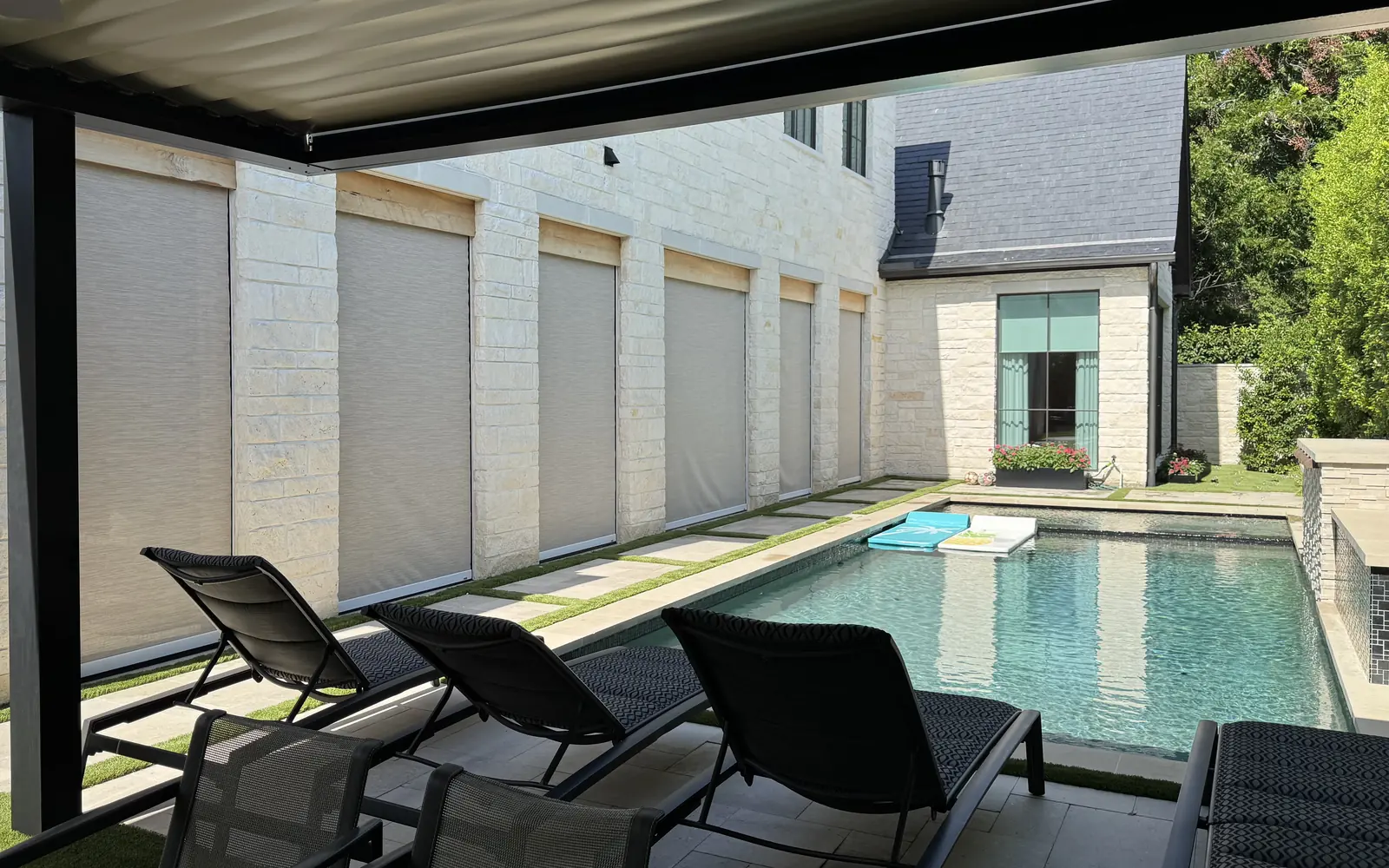
Planned before the ceiling closes.
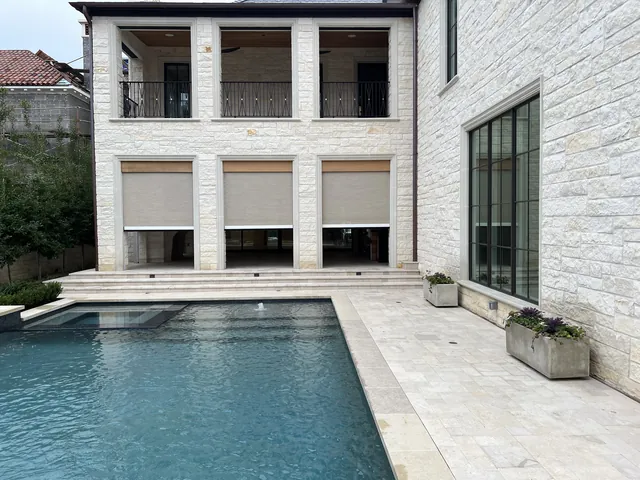
A motorized screen is a pocket in the header, a circuit at the top of the opening and a floor the bottom bar can seal against. Settled on the drawings, it costs almost nothing. Discovered at trim, it costs a soffit.
Three things, on the drawings.
The pocket
A housing pocket framed into the header above each opening, with an access panel, so the screen rolls up out of sight. Sizes are below; we confirm them per opening before framing.
The power
A 120 V feed to the motor end of each pocket, roughed in with everything else rather than run later as a surface raceway. Several screens share a circuit sized for all of them running at once; the numbers are in the rough-in below.
The floor and the jambs
A level slab where the bottom bar lands, and clear jambs for the side tracks. That is what lets a zipper-track screen close the opening to insects.
By mounting, with the numbers.
From the manufacturer’s published installation details. We confirm each opening against the drawings before framing, and the PDF and DWG details are yours on request.
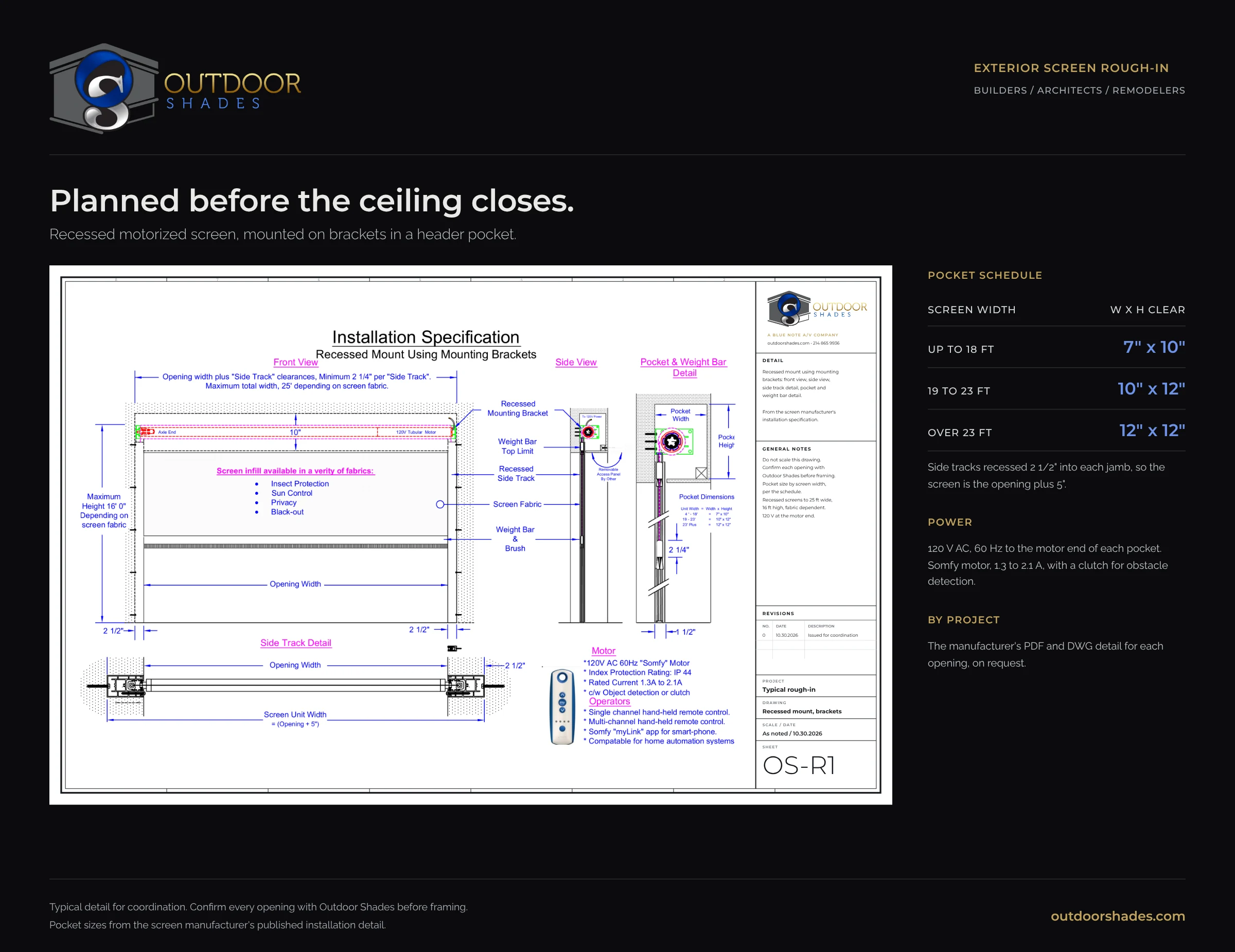
- Recessed pocket
Framed into the header in pre-construction, with a removable access panel and 120 V brought into the pocket at the motor end.
Up to 18 ft wide 7 in wide by 10 in high
19 to 23 ft 10 in by 12 in
Over 23 ft 12 in by 12 inSide tracks are recessed 2 1/2 in each side, so the screen is 5 in wider than the opening.
- Surface mount
A 4.8 in housing on the face of the wall above the opening, with the side tracks on the face of the jambs. Allow at least 2 1/4 in of wall each side for the tracks, which are 2 1/4 in wide and 7/8 in deep.
- Inside mount
The housing sits inside the opening, under the header. It needs 5 in of clear height, and the screen is made 3/4 in narrower than the opening.
- Arched openings
Surface mounted above the arch, with the tracks on the face, so the screen covers the arch as a rectangle when it is down and disappears into its housing when it is up.
- Clear vinyl
The same housing and tracks as a sun screen, with a clear vinyl window in a fabric border, for openings that need to keep out wind, rain and cold. Up to 16 ft wide and 12 ft high.
- Sizes
Zipper-track screens from 36 in wide and 36 in high up to 22 1/2 ft wide and 16 ft high, or 25 ft wide when recessed, depending on the fabric. Bottom bar 2 in or 3 in with a 1 in or 2 in pile seal.
- Power
120 V, 60 Hz to the motor end of each pocket. Somfy rates its exterior-screen motors at 1.3 to 2.1 A each, so several screens share a circuit. Size it for every screen on it running at once, because a wind sensor raises them together, at about 60 percent of the breaker: for the 25 Nm motor (1.6 A) about five screens on a 15 A circuit and seven on a 20 A; for the 35 and 50 Nm motors (2.1 A) about four and five. The electrician sets the final circuits.
- Motors and control
Somfy motors, 120 V, each with a clutch for obstacle detection: if something is in the screen’s path, it stops rather than forcing its way down. Hand-held remote, smartphone app, or the house’s own keypads and automation: ELAN, Control4 and the rest are Blue Note A/V’s work, under the same roof.
Interior shades in the same house? Pocket depth, fascia and dual-roller head details for motorized interior shades are on Blue Note A/V’s page for architects, our parent company.
From the drawings to the handover.
- 01
The drawings
Send the plans and elevations. We note each screened opening, its pocket size, the power location and the floor detail, so they can go into the set before framing.
- 02
Framing
A walk-through once the headers are framed and the electrical is roughed in, while a pocket or a circuit is still easy to move.
- 03
Measuring
Each opening is measured once the finishes around it are in, because the screen is made to the finished opening, not the drawing.
- 04
Installation
Screens are installed three to four weeks after the deposit, and a rush is available when a closing date will not move. We work around the other trades.
- 05
Handover
Every screen set to stop at the same line, the controls shown to the owners, and the warranty and the Spring Service explained before we leave.
The calls do not come to you.
Warranty
The manufacturer covers the screen fabric for ten years, the motor and remote for five, the powder-coated frame for life, and clear vinyl for one year. We guarantee our workmanship for a year from installation.
The Spring Service
Once a year, every screen cleaned and the tracks and moving parts lubricated, so the owners do not call you about a screen two summers later.
Made in Dallas–Fort Worth
The screens are made in Richardson to each measured opening, from heavy-gauge aluminum, in seven standard frame colors (white, textured white, tan, champagne, bronze, textured grey and textured black) or a custom powder coat to any RAL code.
What builders and architects ask us first.
When should a builder call?
Before the headers are framed. A pocket and a circuit planned at drawings cost almost nothing; the same screens added after the ceiling is finished are surface mounted, with the power run to suit.
Can screens go on a house that is already finished?
Yes. Surface and inside mounting need no pocket, and we plan the power route with the electrician and say before we start where anything will show.
Do you work from our drawings?
Yes, and the earlier the better. Send plans and elevations, and we will return each screened opening with its pocket, power and floor detail noted.
Who measures, and when?
We do, once the finishes around each opening are in. The people who measure are the people who install.
What is the lead time?
Most screens are installed three to four weeks after the deposit. A rush is available when a date matters.
Can the screens run with the house automation?
Yes. Blue Note A/V, our parent company, programs ELAN and Control4, so the screens can sit on the same keypads and app as the rest of the house. The Somfy motors join the system through a Bond Bridge for ELAN and a Somfy TaHoma hub for Control4; both are low-voltage, so plan a network drop near the screens.
Read more on this.
 Guide · Trade · New Construction
Patio Screens for Builders and Architects
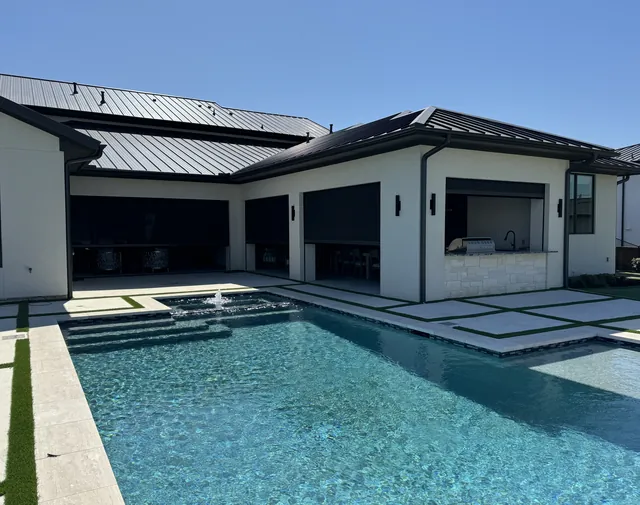
The best time to plan exterior screens is before the headers are framed. Plan the housing pocket, the power and the floor detail in, and the screens disappear into the architecture instead of being worked around at trim.
 Guide · Motorized Screens · Zip-Track & Wind
Zipper-Track Screens and the Texas Wind
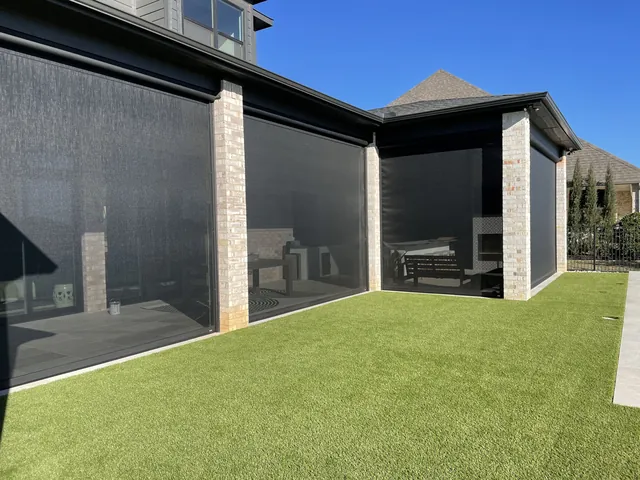
What holds a motorized screen in place when the wind comes up is the track. Here is how a zipper-track screen works, what it handles, and the honest limit — plus the sensor that raises it before a storm can do any harm.
 Guide · Pricing · One Written Price
What Patio Screens Cost, and What Sets the Price
We do not post a single price, because there is not one — each opening is measured and made for it. But the things that move the number are no mystery. Here is what sets the cost of patio screens, and how we quote it.
Start with the free call.
Fifteen minutes tells us both whether screens are the right answer for the patio, and roughly what they involve. No payment, no obligation.
Telephone
214 865 9936Showroom
11410 Mathis Ave, Office 1, Farmers Branch, TX 75234 — our showroom. Monday to Friday, 8:00am to 5:00pm, by appointment
Send a few photographs of the openings and which way they face. That is usually enough for a first answer.
The inquiry form →Screens on the same keypads as the rest of the house, programmed by the same firm.
Blue Note A/V →